UNESCO-listed Golestan Palace undertakes preservation project for historic textiles
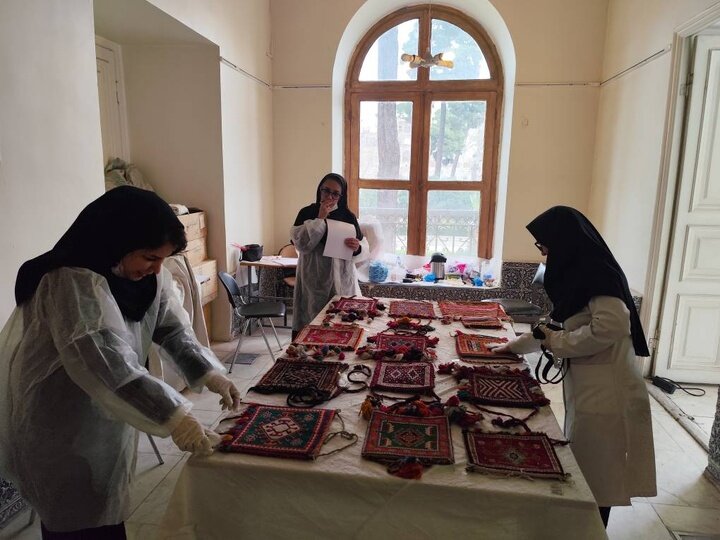
TEHRAN - A comprehensive project to organize, document and conserve a collection of historic textiles housed in the ethnography museum of Golestan Palace has been completed, the site’s director said, as authorities step up efforts to protect material cultural heritage.
Afarin Emami, director of the UNESCO-listed palace complex, said the initiative focused on the physical preservation and systematic management of textile artefacts kept in museum storage, many of which date back to the Pahlavi era.
“The project was launched to safeguard this tangible heritage, given the importance of woven textiles as one of humanity’s earliest achievements in adapting to the environment,” Emami told local media.
The collection includes a wide range of traditional items, such as kilims, nomadic black tents, carpets, jajims, felt pieces, saddle covers, bedding storage bags, khorjins, cushions and decorative elements used in camel trappings. These items had been stored under various classifications, including registered and non-registered holdings.
According to Emami, the project began last year with an initial focus on around 400 pieces, reflecting the significance and diversity of the collection. The process involved detailed scientific procedures, from initial condition assessments to structural reinforcement where needed.
Work began with high-resolution photographic documentation and the preparation of technical identification records for each item. Specialists then conducted preliminary damage assessments before undertaking surface cleaning and dust removal on-site at the museum.
Following evaluations of the textiles’ structural integrity, further conservation treatments were carried out in line with established protocols.
Emami noted that experts identified a range of issues during the process, including surface decay, staining, biological damage, tears and general wear. A key aspect of the project involved detecting and reversing previous non-standard or inappropriate restoration work on some items.
At the conclusion of the project, all artefacts were catalogued with detailed identification tags, including information on name, date and storage location. A comprehensive report documenting the conservation process has been finalized, enabling stricter monitoring and improved preservation conditions for the collection.
Located in the heart of Tehran’s historic core, the palace complex is one of the oldest in the city, originally built during the Safavid dynasty within the historic walled city. Over time, it underwent several expansions, receiving its most defining features in the 19th century, when it was designated as the royal residence and seat of power by the Qajar ruling family.
The palace complex comprises eight main palace structures, primarily used as museums, along with the eponymous gardens, a central green space surrounded by an outer wall with gates, exemplifying the architectural and artistic achievements of the Qajar era, including the integration of European motifs and styles into Persian art. It served not only as the governing base of the Qajar kings but also as a residential and recreational compound and a center of artistic production during the 19th century. Through these activities, it became a primary source and hub of Qajar art and architecture.
Moreover, the property offers a unique and rich testimony to the architectural language and decorative arts of the Qajar period, particularly reflecting the legacy of Naser al-Din Shah. The palace showcases European-inspired artistic motifs alongside Persian traditions, representing some of the earliest examples of a synthesized European-Persian style. This blend became a defining characteristic of Iranian art and architecture in the late 19th and 20th centuries, with parts of the palace complex regarded as foundational to the modern Iranian artistic movement.
AM
Leave a Comment